Key Takeaways
- Nvidia’s 106% year-over-year revenue surge reignited global risk appetite, reinforcing the view that artificial intelligence has crossed the threshold from experimentation to tangible monetization, lifting semiconductor and North Asian equity markets.
- Agricultural commodities and precious metals were the month's standout performers. Weather-related supply disruptions drove wheat up over 18%, while sustained central bank accumulation kept gold price steady.
- The biggest headlines were the most misunderstood. Rising Treasury yields reflected a global sovereign bond repricing rather than a uniquely US problem, while the agricultural rally highlights the risks of extrapolating short-term weather disruptions into long-term investment themes.
Market Review: From Yield Anxiety to Broad-Based Rally
August began with investors fretting over rising Treasury yields and concluded with a robust, broad-based rally across global markets. Despite mid-month bond market jitters, equities, commodities, and precious metals all finished the month stronger, buoyed by renewed confidence in the AI investment cycle, weather-driven supply constraints, and resilient macroeconomic activity.
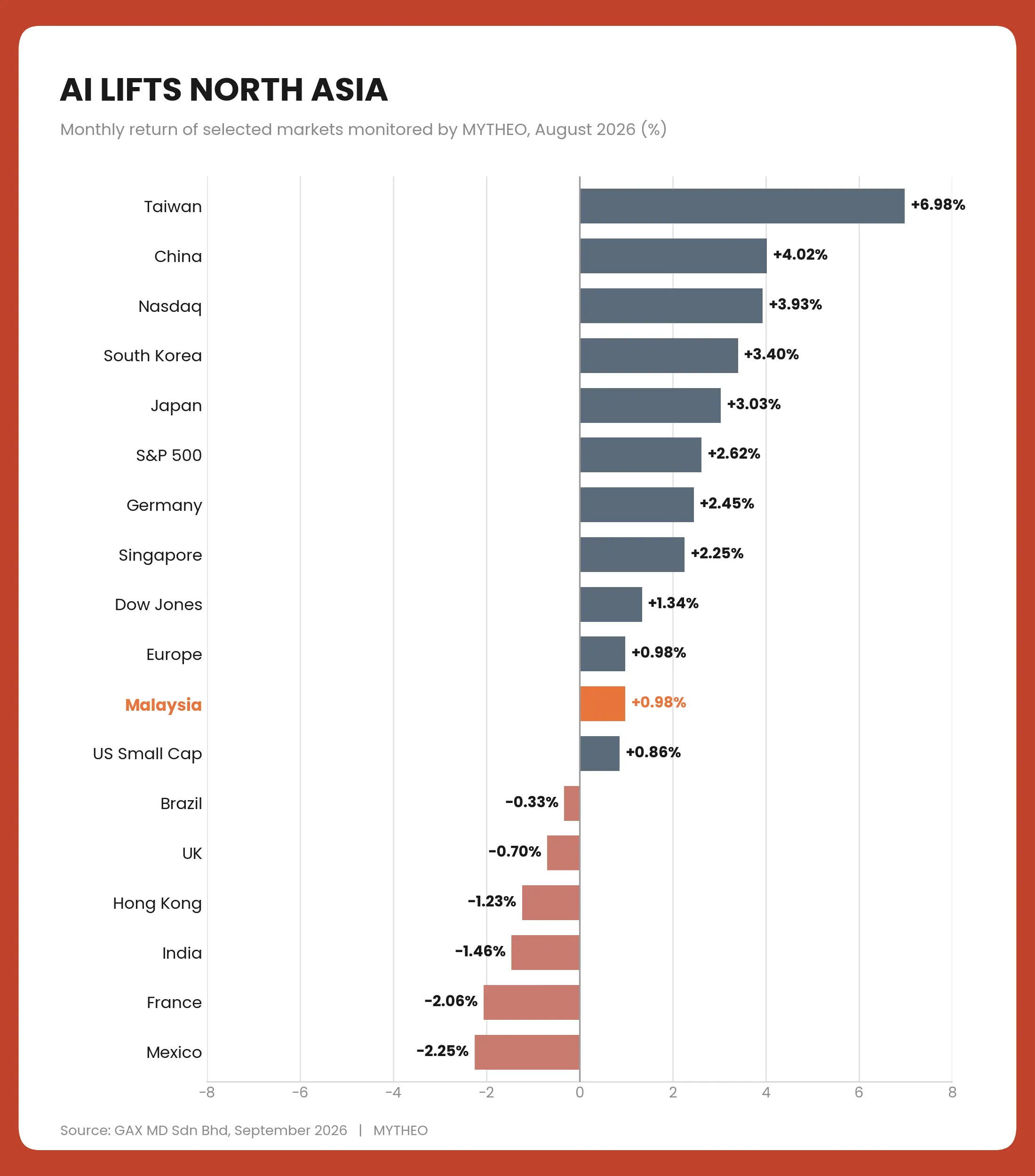
In the United States, equities shook off mid-summer volatility. The tech-heavy Nasdaq Composite led the charge, surging 3.93% and outperforming the broader market. The S&P 500 advanced 2.62%, while the Dow Jones Industrial Average rose 1.34%.
Performance of Selected Markets Monitored by MYTHEO — August 2026
AI Reignites Risk Appetite
The catalyst for the month’s equity rally arrived late in August. Nvidia reported quarterly revenue of US$96.2 billion, a staggering 106% increase year-over-year. More importantly, the company delivered a message that reassured investors about the durability of the AI investment cycle.
Founder and CEO Jensen Huang argued that artificial intelligence has passed a critical inflection point, moving beyond speculative experimentation to generate tangible economic value. AI systems are now performing useful work, the tokens they generate are productive and profitable, and, in Huang’s memorable phrasing, "compute is revenue."
This fundamental validation triggered a sharp recovery in North Asia’s semiconductor complex, which had borne the brunt of earlier market de-risking. Taiwan led global equity performance, followed by China and South Korea, as sentiment toward the semiconductor supply chain decisively improved. Meanwhile, Japan’s Nikkei 225 advanced 3.03%, brushing aside currency volatility to finish the month firmly in positive territory.
Commodities Take the Lead
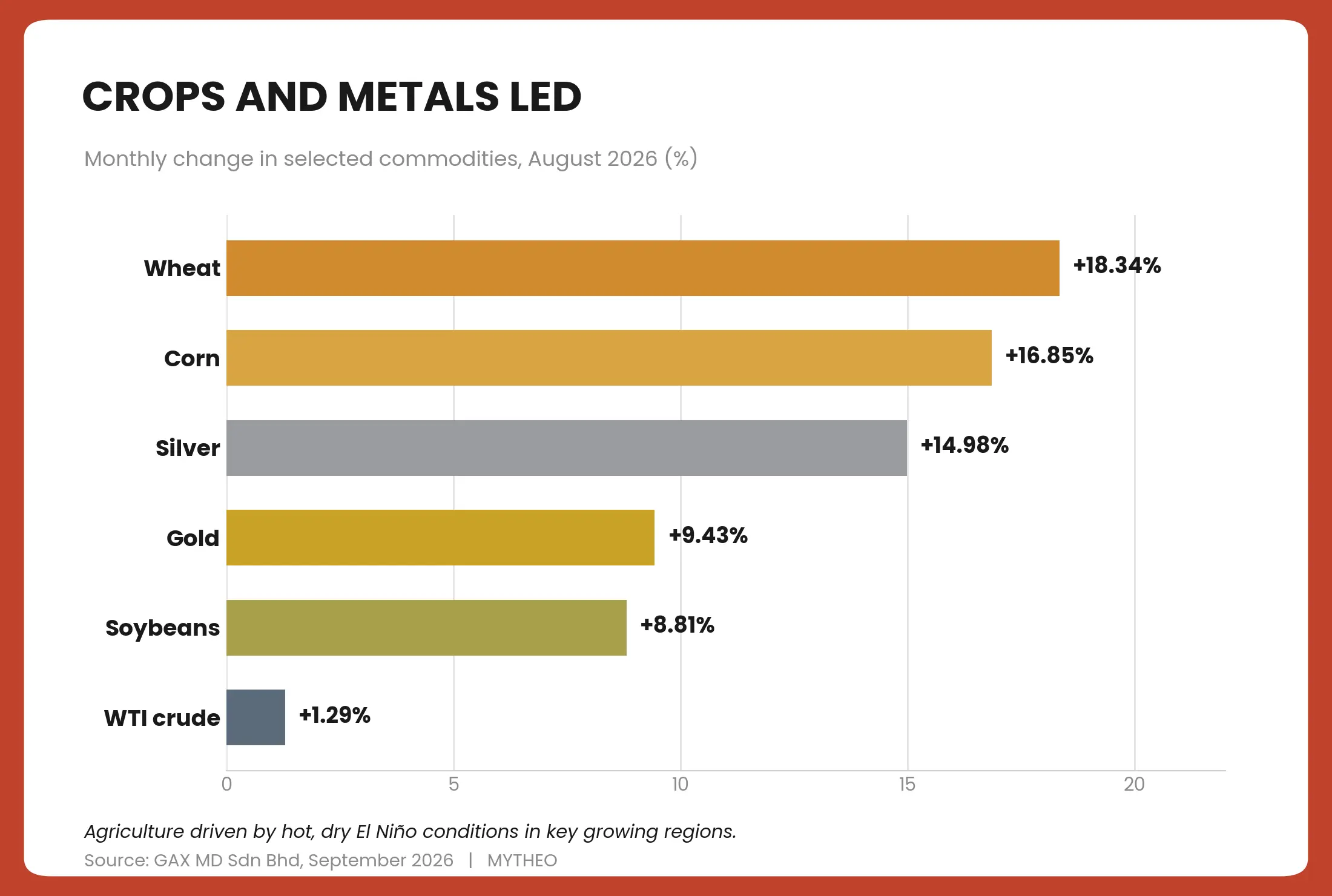
Commodities also enjoyed a strong month, although the standout performers came from agriculture rather than energy.
Wheat led major raw materials with a gain of 18.34%, followed by corn at 16.85% and soybeans at 8.81%. Prices were supported by hot and dry El Nino conditions that disrupted crop production in key growing regions, including Australia for wheat and the US for corn and soybeans.
Precious metals staged an equally impressive rebound. Silver climbed 14.98%, while gold gained 9.43%. The rally in gold was further supported by Goldman Sachs, which reiterated its constructive outlook and forecast a gold price of US$4,900 by the end of 2026, citing relentless demand from central banks seeking to diversify their reserve holdings.
Crude oil, however, was comparatively subdued. West Texas Intermediate (WTI) crude rose just 1.29% during the month as markets continued to assess developments surrounding the Strait of Hormuz and their implications for global energy supplies.
Commodities and the US dollar typically move in opposite directions, and August largely followed that pattern. The US Dollar Index eased 0.37% over the month, while the greenback weakened 1.18% against the Malaysian ringgit (MYR).
Two Narratives Investors Should Question
Beyond the market rally, two dominant narratives shaped investor discussions in August. Both, upon closer inspection, warrant a more nuanced perspective.
- Treasury Yields Reflect a Global Repricing, Not a US Crisis
The first narrative cantered on the sharp rise in US Treasury yields. The US 10-year Treasury yield ended the month at 4.758%, its highest month-end level since October 2023. Headlines quickly framed this move as a uniquely American problem, sparking fears that investors should reduce exposure to fixed income.
We believe the market is oversimplifying the story. The rise in sovereign bond yields has been a global phenomenon, not a US-specific event. Bond markets across developed economies have been repricing higher as investors reassess inflation expectations, fiscal spending requirements, and long-term growth assumptions. Viewed through this broader lens, the increase in Treasury yields reflects a global adjustment in capital markets, not a structural weakness in US fixed income.
The performance of the MYTHEO Income Portfolio during August illustrates this distinction perfectly. Despite maintaining more than 70% exposure to US dollar-denominated assets, the portfolio generated positive returns in both USD and MYR terms, with every underlying holding contributing positively during the month.
The Federal Reserve's decision on 16 September further reinforced this view. Policymakers delivered a widely anticipated 25 basis point rate hike, raising the benchmark rate to a target range of 3.75% to 4.00%. The decision was approved unanimously, compared with the July meeting when only three policymakers supported a hike. Updated projections also indicate that another increase remains possible before year end.
Importantly, financial markets showed little reaction to the announcement. This muted response suggests investors had already largely priced in the move, viewing it as incremental policy fine-tuning rather than a major shift in the monetary policy outlook.
For a deeper analysis, read our dedicated article: Why Malaysian Bond Investors Were Hit Harder Than US Bond Investors
- El Nino Not a Long-Term Investment Theme
The second narrative centred on El Nino. The strong performance of agricultural commodities led many investors to view the sector as one of the most attractive opportunities in the market. However, history suggests caution. Weather-driven commodity rallies are often powerful but temporary. Agricultural markets tend to normalize once supply conditions improve, making them difficult for long-term thematic investing.
This is precisely why the MYTHEO Essential and Inflation Hedge portfolios are not structured as pure agricultural or El Nino strategies. Agriculture contributes positively to both portfolios, but it sits alongside a broader collection of structural themes and real assets. Such diversification allows investors to benefit from short-term opportunities without becoming overly reliant on a single macro event.
For a deeper analysis, read our dedicated article: Weathering the Heat: Turning the "Strongest El Nino in Living Memory" into a Structural Investment Strategy
Conclusion
Concerns over an “AI bubble” faded once again after Nvidia's latest results. This pattern has repeated itself throughout the year. Whenever markets move between earnings seasons, investors question whether AI valuations have run too far. Yet each earnings season has so far reinforced the same message: artificial intelligence is increasingly generating real economic value. While volatility around the theme is likely to continue, investors may be better served by focusing on fundamentals rather than short term sentiment swings.
Looking ahead, October to December is also expected to mark the peak of El Nino conditions, which could continue to support agricultural commodities. However, we caution investors against chasing the rally. Weather-driven commodity cycles are notoriously unpredictable and often reverse sharply once conditions normalise.
Furthermore, markets should avoid viewing the latest Federal Reserve rate hike through the lens of 2022. The two episodes are fundamentally different. In 2022, rates rose from near-zero levels and increased by a cumulative 425 basis points across seven hikes, triggering a broad, painful repricing across all financial assets. Today, policy rates are already above the Fed's estimated neutral rate of 3.75%. This suggests that any additional tightening is more likely to represent routine policy housekeeping than a structural shift in the interest rate outlook. While higher rates deserve monitoring, the current adjustment is far less disruptive than the tightening cycle investors experienced four years ago.
Ultimately, successful investing is rarely about correctly predicting a single theme. It is about maintaining exposure to multiple, uncorrelated sources of return. The MYTHEO Income Portfolio benefited from resilient fixed income markets, while the MYTHEO Essential and Inflation Hedge portfolios captured gains from the agricultural rally. Rather than chasing headlines, we continue to believe that disciplined, diversified portfolio construction remains the most effective way to navigate an increasingly complex market environment.
Ready to explore how MYTHEO works for your goals? Learn more here.
Or download our app so you can start investing in a moment. Download on iOS here or Android here.
To register for MYTHEO, you can get started here.
This material is subject to MYTHEO’s Notice and Disclaimer.